Our Mission
To transform 92 million hectares of degraded South African land into carbon-negative, cost-competitive 24/7 baseload power — creating permanent jobs and restoring ecosystems at scale.
The Challenge We're Solving
Before: Degraded Land Liabilities
92 million hectares of land (South Africa) and 228 million hectares (Southern Africa) degraded by overgrazing, erosion, and climate change — unable to support food crops. Mining and coal operations leave additional legacy liabilities requiring costly rehabilitation.
After: OFI Cactus Infrastructure
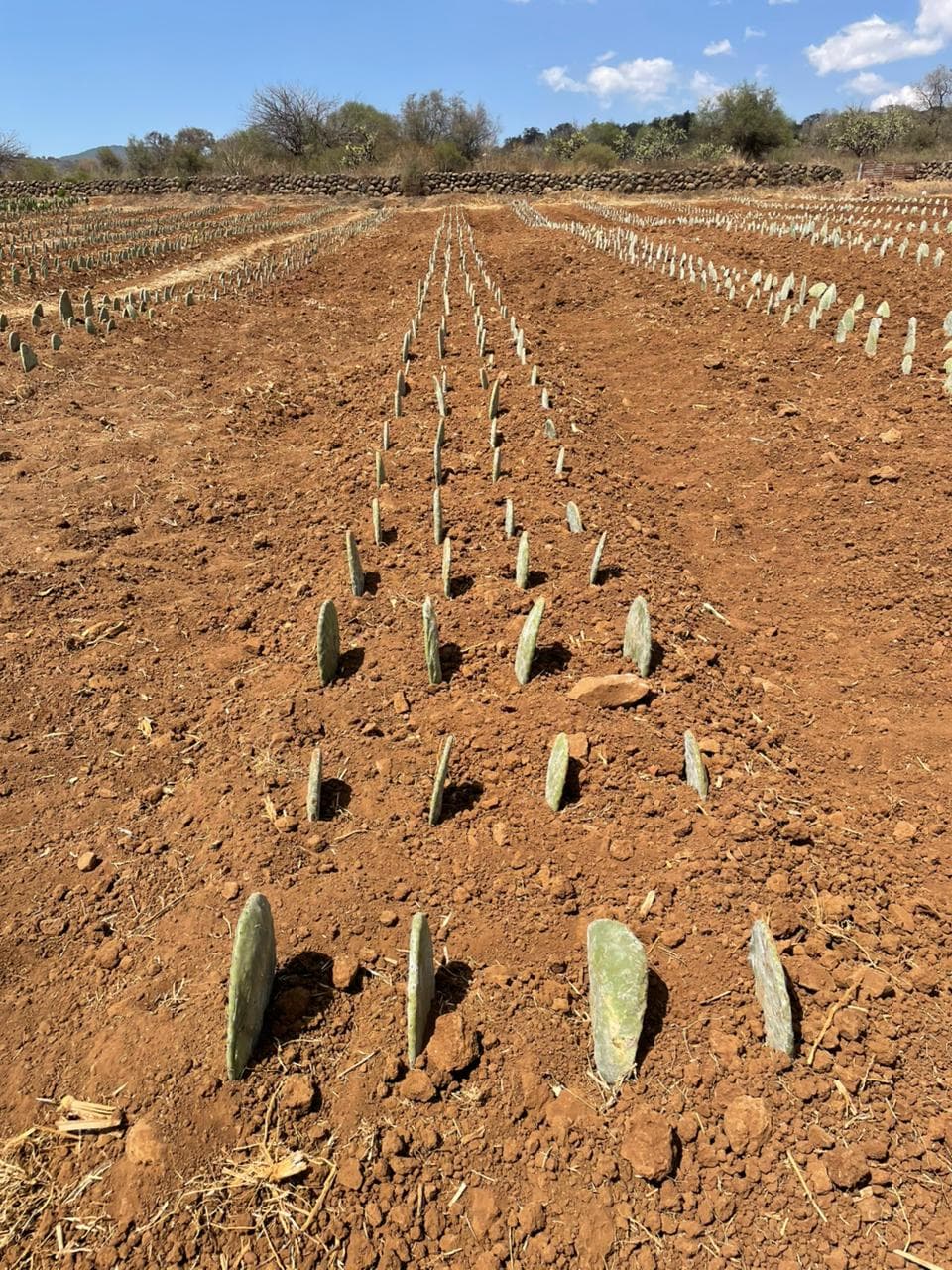
OFI cactus farms that restore soil carbon, provide drought-resistant biomass, and generate clean 24/7 baseload power — transforming liability into revenue-generating infrastructure.
Power deficit as South Africa's coal fleet retires and demand grows — Eskom's aging infrastructure cannot meet industrial needs.
South Africa
Southern Africa
SA Potential
SADC Potential
Theoretical biomethane capacity from restored land
Realistic rollout: 138-230 GWe (SA) | 342-570 GWe (Southern Africa) accounting for grid integration and phased deployment constraints.
First-Principles Solution
The physics are simple: OFI cactus (Opuntia ficus-indica) is the most efficient photosynthesis system in arid climates. Each hectare captures 30 tonnes of atmospheric CO₂ annually — delivering net carbon sequestration of 60+ tCO₂e/ha/yr when accounting for soil restoration and avoided fossil fuel emissions. Requires only 300mm annual rainfall (80% less water than conventional bioenergy crops).
The chemistry is established: Anaerobic digestion converts cactus biomass into pipeline-grade biomethane — the same proven technology used in thousands of commercial biogas plants worldwide. 97% CH₄ purity via pressure swing adsorption upgrading.
The engineering is proven: Combined heat and power (CHP) engines from Jenbacher and Caterpillar achieve 90-95% availability, delivering reliable baseload electricity with 85% total system efficiency (electrical + thermal).
Our Values
Execution Over Theory
We prove concepts in the field, not in spreadsheets.
First-Principles Thinking
We solve problems from fundamental physics, not convention.
Sustainable Impact
Every project must restore ecosystems and create permanent local jobs.
Institutional Excellence
We build infrastructure-grade assets with 30-year operating lifetimes and institutional governance.
The Southern Africa Biomethane Opportunity
Degraded and arid land across Southern Africa represents the continent's largest untapped infrastructure asset — 228 million hectares that can be transformed into productive biomethane farms and 24/7 baseload power infrastructure.
The Scale
Theoretical capacity — sufficient to power 60× South Africa's peak demand
Realistic Rollout
Addressable opportunity accounting for grid integration and capital constraints
South Africa Alone
Potential from 92M ha degraded land — 24× current installed generation
The Vision
Transform Southern Africa from energy-deficient to energy-abundant — creating the world's largest biomethane corridor while restoring ecosystems, creating permanent jobs, and enabling SADC regional industrial transformation.
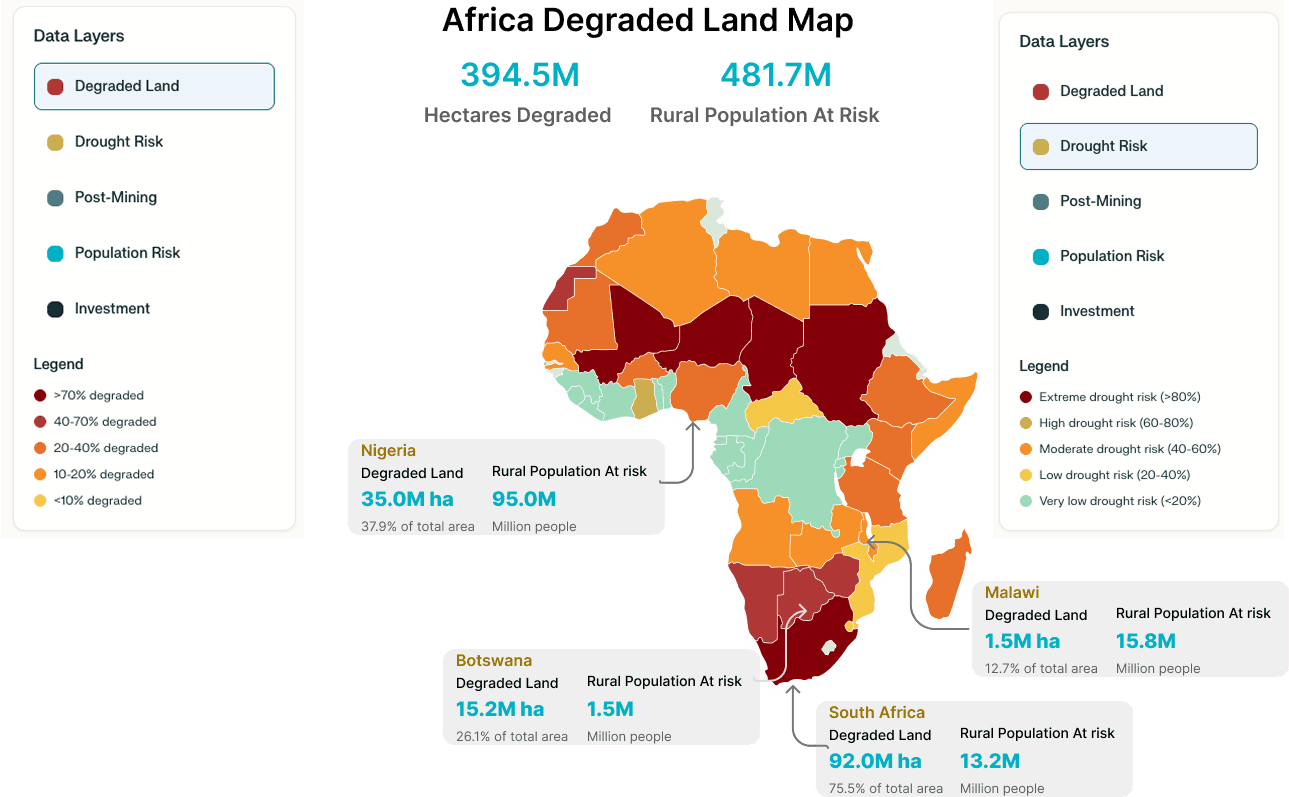
394.5M Hectares Degraded
481.7M Rural Population At Risk
847 GW Potential
Biomethane Capacity